The Data Guy’s Portfolio:

A showcase of data science experiments and notebooks to highlight important concepts and methodology
Hi!
I am the data guy and I am a data scientist with a passion for big data and machine learning.
In my free time, I love to undertake popular experiments in data science to sharpen my skills and knowledge base. I have documented that journey here in python using a series of informative Jupyter notebooks. Feel free to explore them in the blog!
🌌 Getting Started- The Data Science Galaxy
Welcome to the universe of modern data science which spans mathematics, machine learning, engineering, and production systems.
For more information, please see the following -
🌌 Data Science Ecosystem & Machine Learning Pipeline
From Raw Data to Intelligent Systems
🧠 What is Data Science?
Data science transforms raw data into insights, predictions, and intelligent systems by combining statistics, computing, and domain knowledge.
Field Purpose ——————— —————————– 📊 Statistics Understanding uncertainty 💻 Computer Science Building scalable systems 🤖 Machine Learning Predictive modeling 🧠 Domain Expertise Solving real-world problems
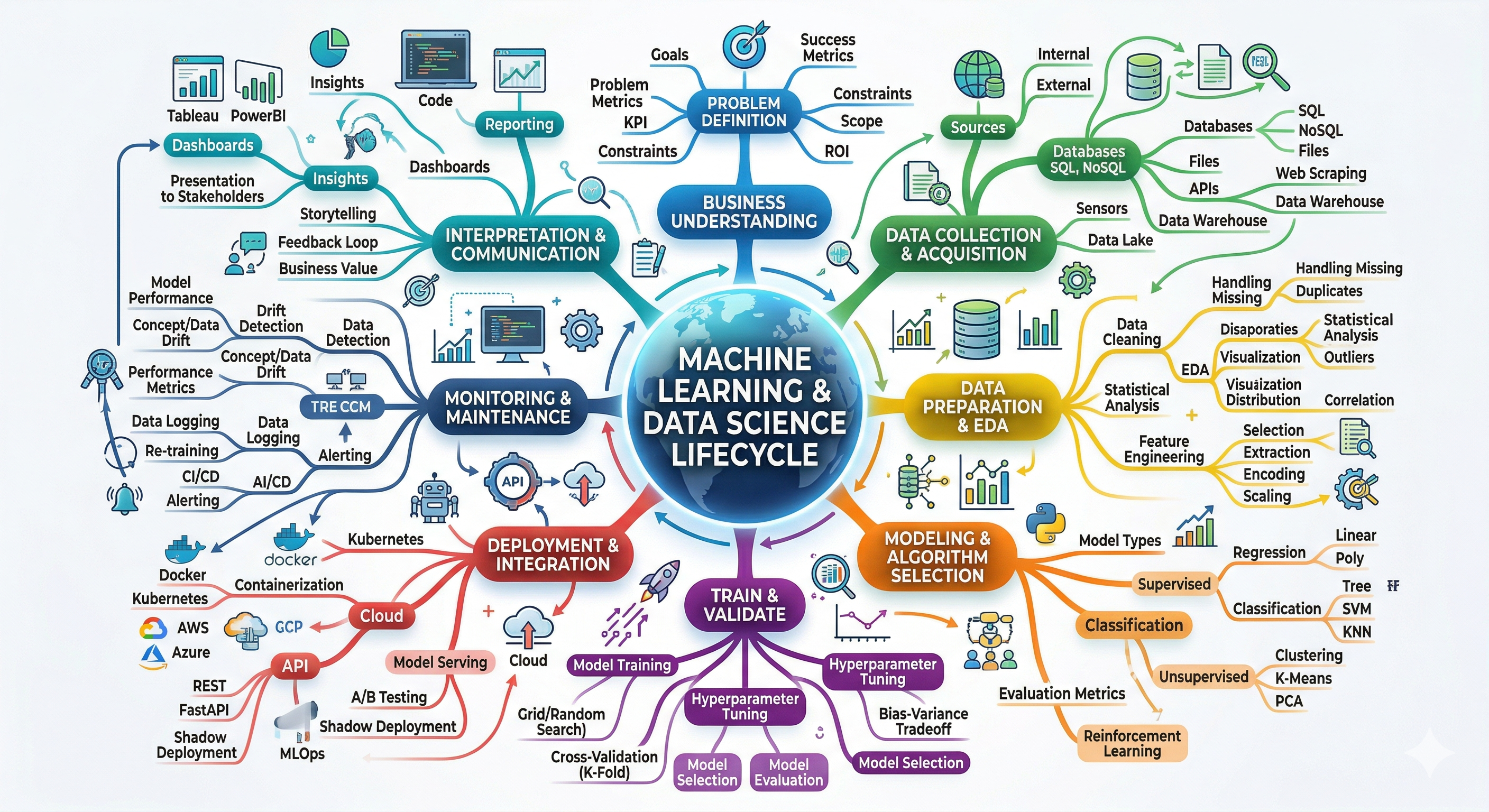
🌍 The Data Science Pipeline
Data Sources
      ↓
Data Engineering
      ↓
Exploratory Data Analysis
      ↓
Feature Engineering
      ↓
Machine Learning
      ↓
Model Evaluation
      ↓
Deployment
      ↓
Monitoring
      ↓
Retraining
Modern machine learning systems operate as continuous feedback loops.
📦 Data Sources
Common origins of data:
- APIs
- Databases
- Web scraping
- Sensors / IoT devices
- Logs
- Financial transactions
- Public datasets
Example data types:
User activity logs
Medical records
Financial transactions
Satellite imagery
Social media data
🏗 Data Engineering
Data engineering prepares raw data for analysis.
Typical tasks:
- ETL pipelines (Extract, Transform, Load)
- Data cleaning
- Handling missing values
- Data validation
- Data warehousing
Common tools:
Python
SQL
Apache Spark
Airflow
Kafka
Hadoop
🔍 Exploratory Data Analysis (EDA)
EDA helps analysts understand patterns within data.
Typical steps:
Load dataset
Inspect features
Visualize distributions
Analyze correlations
Identify anomalies
Generate hypotheses
Visualization libraries:
Matplotlib
Seaborn
Plotly
Altair
🧬 Feature Engineering
Feature engineering converts raw data into predictive signals.
Examples:
Raw Feature Engineered Feature —————— ————————- Timestamp Day of week Purchase history Customer lifetime value Text TF‑IDF vectors Images CNN embeddings
Common operations:
Scaling
Encoding
Aggregation
Dimensionality reduction
Text vectorization
🤖 Machine Learning
Machine learning algorithms learn patterns from historical data.
Supervised Learning
Examples:
Spam detection
Fraud detection
Medical diagnosis
House price prediction
Algorithms:
Linear Regression
Logistic Regression
Random Forest
Gradient Boosting
Neural Networks
Unsupervised Learning
Examples:
Customer segmentation
Anomaly detection
Topic modeling
Algorithms:
K-Means
DBSCAN
Hierarchical Clustering
PCA
Autoencoders
🧠 Deep Learning
Deep learning uses multi‑layer neural networks to learn complex patterns.
Applications:
Computer vision
Natural language processing
Speech recognition
Generative AI
Frameworks:
TensorFlow
PyTorch
Keras
JAX
📏 Model Evaluation
Models must be validated before deployment.
Classification Metrics
Accuracy
Precision
Recall
F1 Score
ROC-AUC
Regression Metrics
MAE
MSE
RMSE
R²
Validation workflow:
Train/Test Split
Cross Validation
Hyperparameter Tuning
Final Model Selection
🚀 Model Deployment
Deployment methods:
REST APIs
Batch pipelines
Real-time inference
Mobile / Edge AI
Common deployment stack:
FastAPI
Docker
Kubernetes
AWS / GCP / Azure
Example architecture:
User Request
     ↓
API Gateway
     ↓
Model Service
     ↓
Prediction
     ↓
Response
📡 Monitoring & MLOps
Machine learning models degrade over time due to data drift.
Challenges:
Data drift
Concept drift
Model decay
Latency issues
Monitoring tools:
MLflow
Weights & Biases
Prometheus
Grafana
EvidentlyAI
🔁 Continuous ML Lifecycle
Raw Data
   ↓
Data Cleaning
   ↓
Feature Engineering
   ↓
Model Training
   ↓
Evaluation
   ↓
Deployment
   ↓
Monitoring
   ↓
Retraining
This loop powers modern AI-driven systems.
🌐 Data Science Technology Stack
Programming
Python
R
Julia
Scala
Data Processing
Pandas
NumPy
Apache Spark
Dask
Machine Learning
Scikit-learn
TensorFlow
PyTorch
XGBoost
LightGBM
Data Storage
PostgreSQL
MongoDB
Snowflake
BigQuery
Redshift
Visualization
Matplotlib
Plotly
Tableau
Power BI
🌍 Real‑World Applications
Netflix → Recommendation systems
Amazon → Demand forecasting
Tesla → Autonomous driving
Google → Search ranking
Banks → Fraud detection
Hospitals → Disease prediction
🧭 Roles in the Data Science Ecosystem
Role Focus —————- —————————— Data Engineer Data infrastructure Data Analyst Insights and reporting Data Scientist Modeling and experimentation ML Engineer Production ML systems AI Researcher Algorithm development
Data science is a complete ecosystem combining:
Engineering
Statistics
Machine Learning
Software Development
Domain Expertise
Together these disciplines transform raw data into intelligent systems.